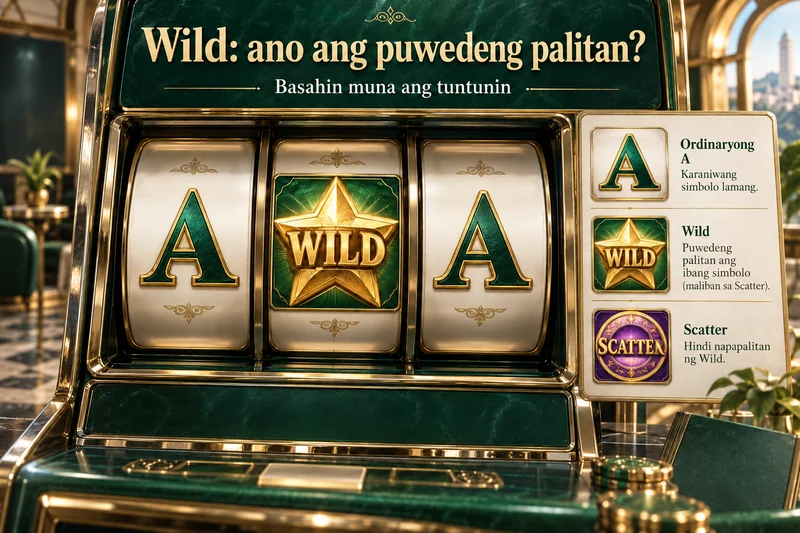
A Wild can complete an ordinary symbol combination without becoming a Scatter or triggering free spins. To read a result correctly, you need three details from the exact game: what the Wild replaces, when it takes effect, and how overlapping awards are counted.
For the topic overview, see Slot Game Reviews Philippines.
This SlotVIP guide separates those questions with a small fictional paytable, then looks at the transformation wording in Mahjong Ways and Super Ace. It is a reading exercise, not a method for predicting a Wild or choosing a profitable moment to spin.
Start with the substitution rule
Find the sentence that names the symbols a Wild may replace. Check the exceptions beside it: a Scatter, a jackpot symbol and a collection symbol can have separate functions. A star, a gold frame or the word “special” is not enough to identify the rule.
Then check where the Wild can appear and which positions are being evaluated. A completed row is only relevant if it meets the game's paying structure. Our paylines, ways and clusters guide explains that distinction; the paytable guide covers the stake or credit unit used for an award.
One Wild, two different counting tasks
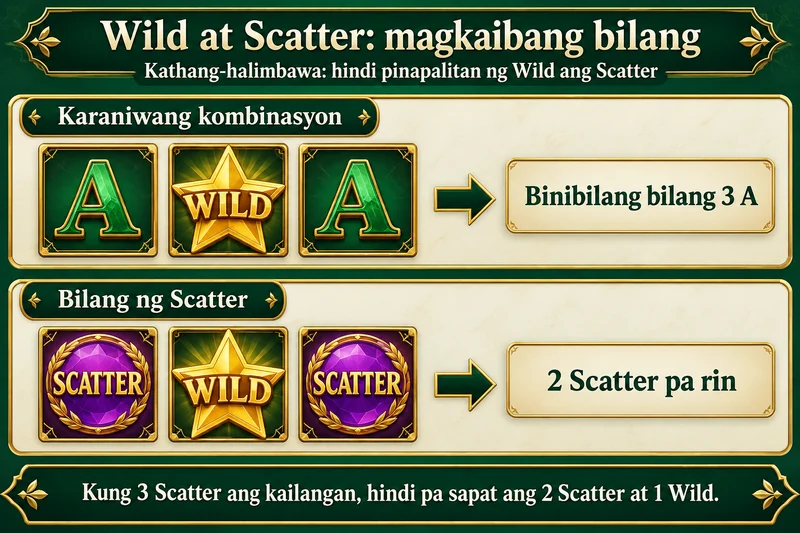
For this invented example, assume a three-reel game with one active horizontal payline. A Wild replaces A on that line, but never replaces Scatter. Three A symbols award 20 units. Three Scatters are required for a feature. These are our example rules, not the paytable of either game discussed below.
| Three visible symbols | What the example rules count | Result |
|---|---|---|
| A · Wild · A | Three A on the active line | The 20-unit A award qualifies |
| Scatter · Wild · Scatter | Two Scatters | The three-Scatter feature condition is not met |
| Scatter · Scatter · Scatter | Three Scatters | The feature condition is met; its eventual return is a separate result |
The Wild has not “failed” in the second row. The question changed from completing an ordinary combination to counting a special trigger. There are three symbols visible, but only two belong to the required type. Read the Scatter guide for position and trigger-timing checks.
The same separation matters when Wilds have their own prize. Add a hypothetical rule that three Wilds pay 30 units, while their substitution as three A would pay 20, and that only the highest applicable award on a line is paid. A Wild–Wild–Wild line then pays 30 units, not 30 + 20 = 50. If a real game's rules instead add specified awards, use that rule. The symbol picture alone cannot settle the question.
Gold now does not necessarily mean Wild now
PG SOFT's Mahjong Ways manual, sections 2.2–2.3, excludes Scatter from Wild substitution. It places gold-plated symbols on reels 2–4 and says qualifying gold symbols involved in the previous win transform into Wilds at the next round after new symbols cascade down.
The practical distinction is between the symbol's current identity and a later transformation. When following a replay, note what was evaluated before the cascade, what changed afterwards, and which state the next evaluation uses. Do not retroactively treat every gold symbol as a Wild. Our Mahjong Ways research review provides the wider game context.
JILI's Super Ace product page describes Golden Joker appearing after Golden Card is eliminated. That short statement does not establish every substitution exception, timing detail or interaction. The Super Ace review keeps the documentation gaps visible; do not import Mahjong Ways rules merely because both games use gold transformations.
Read the boundary of each Wild feature
Names such as sticky, expanding, moving and multiplying describe a behaviour. They do not answer every question needed to evaluate a result.
- Sticky: does the Wild remain for another cascade, a set number of spins or an entire feature? What ends that state?
- Expanding: does expansion happen before or after the relevant award is evaluated, and which positions does it cover?
- Moving: where does it move, and is a moved symbol evaluated before it leaves the reels?
- Multiplier: what award does it multiply? If two effects apply, do the rules add them, multiply them or impose a cap?
Keep the answer beside the feature name in your notes. If the documentation does not answer it, record “not established” rather than filling the gap with another game's familiar rule.
A useful note for an unclear round
Save the exact title and version, round ID, total stake, active mode, relevant rule and the sequence of displayed states. Separate an ordinary award from a feature trigger and from the final settled total. A single screenshot may omit the cascade that created the Wild or the rule that limits its effect.
A qualifying combination can still return less than the amount spent on the round. A feature trigger is not itself a statement of net profit. For a transaction dispute, use the operator's documented support process; SlotVIP publishes research and cannot change a balance.
Sources, changes and limits
Updated 4 October 2026. We directly read the official PG SOFT manual and JILI product page linked above. The three-reel table and 20/30-unit comparison are original hypothetical examples. The update adds a clearer boundary between substitution, Scatter counting and transformation timing; it does not claim a real-money play session, an operator configuration check or independent human review. Research and writing are AI-assisted under the existing SlotVIP Editorial Desk byline.