A mean slot award can be positive while the median award is zero
Published — UTC

A positive average award does not mean most rounds returned money. One larger award can raise the arithmetic mean while the middle observation remains zero.
Nine original observations
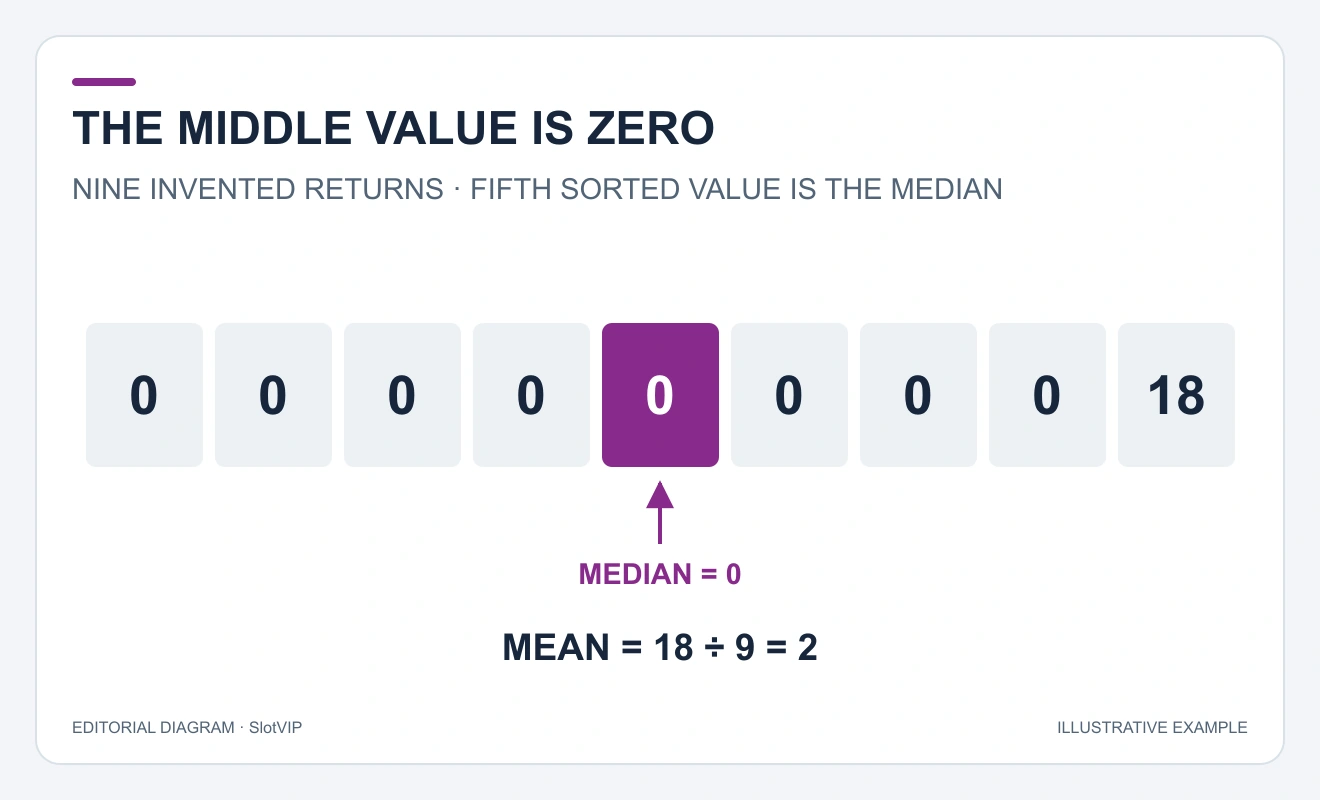
Assume nine fictional settled rounds each cost 1 unit. Their returns, already sorted, are:
0, 0, 0, 0, 0, 0, 0, 0, 18
| Measurement | Calculation | Result |
|---|---|---|
| Mean award | 18 / 9 | 2 units per round |
| Median award | Fifth sorted observation | 0 units |
| Session net | 18 returned − 9 staked | +9 units |
Python's statistics reference distinguishes the mean and median. The sample above is invented and does not describe measured SlotVIP gameplay.
Use the label that answers the question
The mean distributes the total return across the nine observations. The median identifies their middle value. Neither says that a particular future round returns two units. The sample net describes this one constructed sequence only.
Stake changes create another distinction: mean award per round is not automatically return divided by total stake. Keep round count, accepted stake and returns separately rather than attaching “RTP” to every average.
Show the distribution instead of one headline
Retain the number of zero-return rounds and the full sample boundary. A collection containing only the 18-unit award would not support the nine-round statistics.
The same mean can describe another shape
Compare a second constructed sample containing nine returns of 2. It also totals 18, has a mean of 2 and, at a 1-unit cost per round, has net +9. But its median is 2 and all nine rounds return money. In the first sample, the median is zero and only one of nine rounds pays. The common mean and net do not describe that difference.
Change the large observation and check both measures
If the first sample's final return changes from 18 to 27 while the other eight remain zero, the mean rises from 2 to 3. The median remains zero because its fifth sorted value is unchanged. This is why the two measures can move differently when one extreme observation changes.
With an even number of numeric observations, the conventional median averages the two middle sorted values. For the separate sample 0, 0, 0, 0, 0, 0, 0, 0, 18, 30, the fifth and sixth values are both zero, so its median is still zero. Its mean is 48 / 10 = 4.8. A median need not generally equal one observed value when the two middle values differ.
Retain losing and missing records correctly
Keeping only the 18-unit return makes a one-row dataset with mean and median both 18. It does not summarize the original nine rounds. Missing rows are also different from confirmed zero returns; replacing unknown awards with zero would create observations that were never established.
If the ninth round instead cost 4 while each of the other eight cost 1, total stake would be 12. The same 18-unit return total would then give an observed return-to-stake ratio of 150%, rather than 200% under the original 9-unit stake. Mean award per round remains 2. Report the scope and denominator; none of these constructed ratios measures theoretical RTP.