GUIDE · SlotVIP
Two slot sessions, one return rate: why the simple average fails

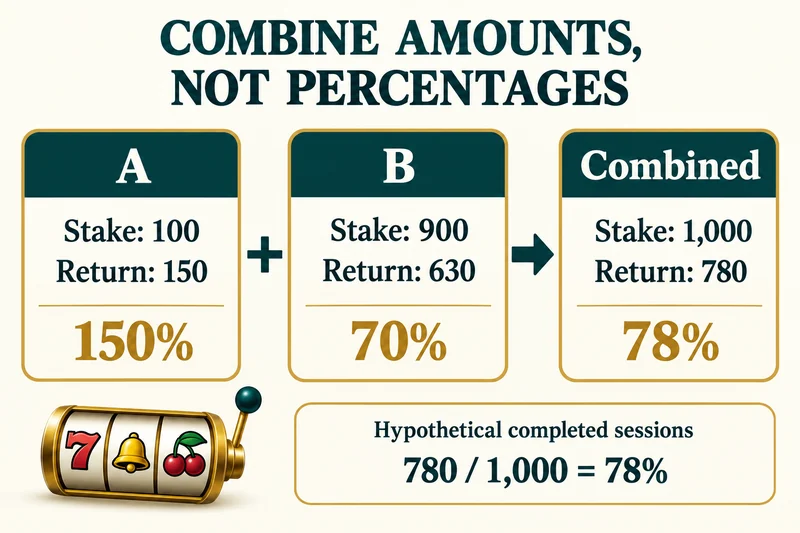
A short session returned 150% of its stakes. A longer one returned 70%. Their combined return is not necessarily 110%. To find what actually happened across both, add the money amounts before calculating the percentage.
This matters when a spreadsheet, session history or personal note gives each session equal space even though one contains much more gambling. The following figures are invented, completed records in a single currency. They are not results from a tested game.
The larger session carries more of the total stake
| Record | Total stakes | Gross returns | Observed return |
|---|---|---|---|
| A | PHP100 | PHP150 | 150% |
| B | PHP900 | PHP630 | 70% |
| Combined | PHP1,000 | PHP780 | 78% |
The combined calculation is (150 + 630) ÷ (100 + 900) × 100 = 78%. In money terms, the records show PHP1,000 staked and PHP780 returned, a net loss of PHP220.
Taking (150% + 70%) ÷ 2 gives 110%, because that calculation gives each session half the weight. But session A accounts for only one tenth of the stakes. The correct weighted version is 0.10 × 150% + 0.90 × 70% = 78%. A profitable small session does not cancel a larger loss simply by occupying one row.
When would averaging the two percentages work?
If both sessions had exactly the same total stakes, an ordinary average would give the same answer as the ratio of totals. For example, PHP100 returning PHP150 and another PHP100 returning PHP70 would combine to PHP220 ÷ PHP200 = 110%. Changing the second stake changes the answer; changing a session label does not.
Spin count alone is not a substitute for stake weight. Ten spins at PHP1 and ten at PHP10 have equal round counts but different amounts at risk. Use total stakes from the records, including repeated wagers of previously returned money. A deposit total answers a different question.
Keep the records comparable
Before combining rows, check the currency, period and meaning of “return.” Here it means gross credited game awards, before subtracting the corresponding stakes. A field labelled “profit” already subtracts cost and cannot be dropped into the gross-return column. The five-round return and net-loss example shows that distinction one round at a time.
Include losing and zero-return records, not just screenshots of awards. Resolve missing settlements separately; an unfinished feature with an unknown award should not silently become a completed zero. If different exports overlap, remove duplicate round IDs before adding them.
A correct historical percentage is still not a forecast
The UK Gambling Commission's RTP monitoring explanation calculates observed return from wins divided by turnover and distinguishes it from the designed value. That UK reference supplies a measurement method, not an assessment of a Philippine operator.
The 78% above describes only our invented records. It does not establish a game's theoretical RTP, predict the next session or imply that a loss is due to be repaid. Keep the meaning of theoretical RTP separate from this bookkeeping calculation. An accurate total is useful for understanding spending; it is no reason to extend a session to reach a preferred percentage.
Explore the SlotVIP guide library for related explanations, or return to SlotVIP.
AI-assisted source research and original explanation. No gameplay, payments or operator-availability testing was performed. Sources checked 2026-10-08.